.svg)
The Impact of Quantum Computing on the Economy, Technology, Security
Quantum computers are widely regarded as the next major technological revolution, and research in the field has been advancing rapidly for years.
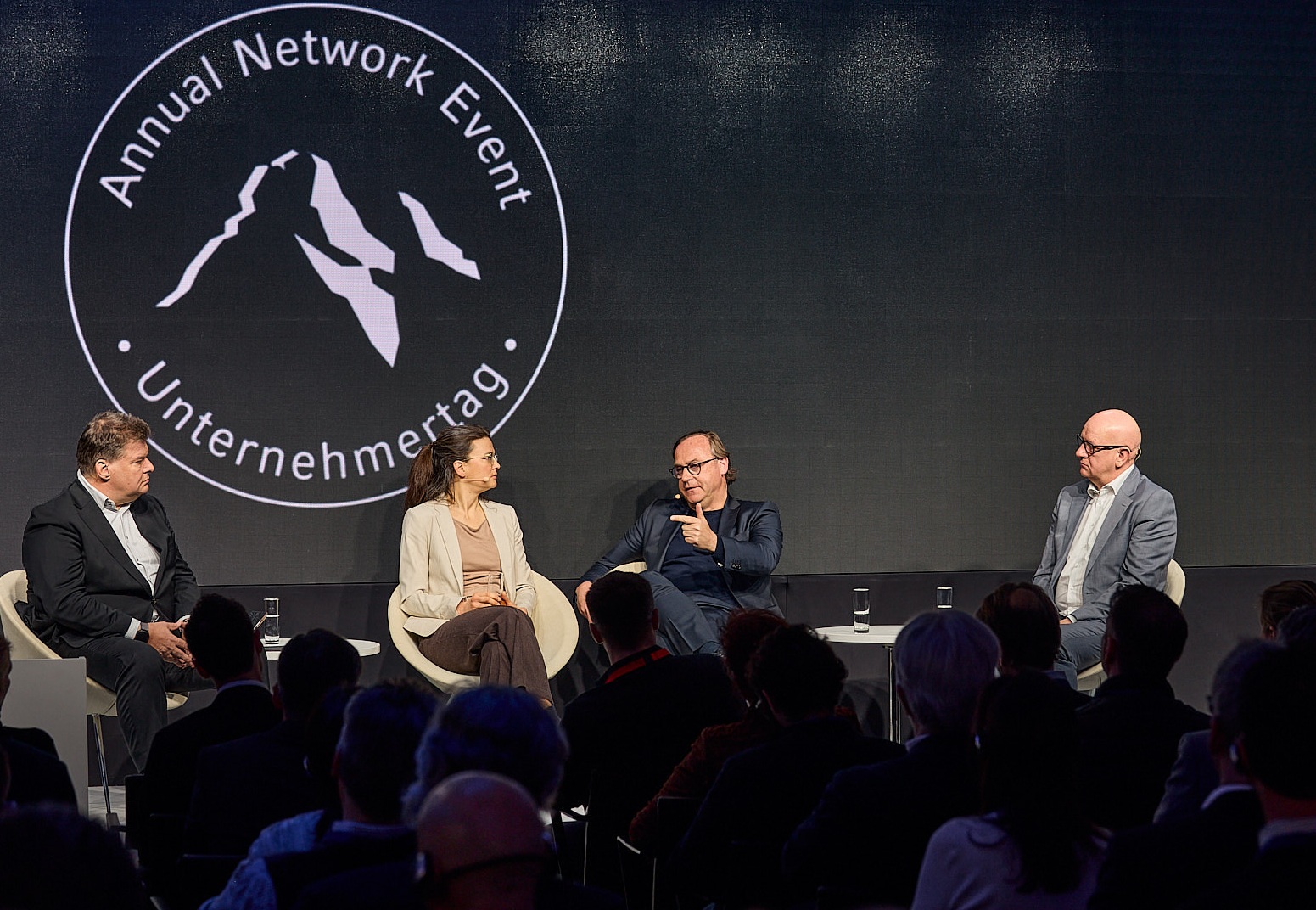
The panel brought together three key perspectives: research, start-up and corporate, represented by Regina Finsterhölzl (Senior R&D Scientist, Quantinuum), Markus Pflitsch (CEO, Terra Quantum) and Thomas Treml (Cloud CTO, Microsoft Germany). The discussion was hosted by Marc Kowalsky (deputy editor-in-chief BILANZ).
A central question was whether Europe can keep pace in this technological race.
Against this backdrop, Markus Pflitsch (“Quantum AI is AI on steroids”) warned emphatically that, despite its strong base of talent and research, Europe risks falling behind. He argued that excessive regulatory and structural hurdles in Germany and the EU are holding back founders, while the United States and China are investing billions into quantum technologies. Just three weeks after Unternehmertag, he announced plans to relocate his Munich-based company to the United States and pursue an IPO there. Quote from the Frankfurter Allgemeine Zeitung: ‘The German founder of the software specialist came up against many closed doors in Germany.’
Key takeaways from the discussion:
• An exponential technological leap
Quantum computing is not an incremental upgrade but a fundamentally different computational paradigm, offering exponential performance gains with potentially disruptive effects comparable to, or even exceeding, those of artificial intelligence.
• Technological maturity: progress, but no breakthrough yet
Hardware has advanced significantly in recent years. Current systems enable early applications and testing, but remain too small and error-prone for widespread industrial use. Scalability and error correction remain core challenges.
• Applications with vast potential
Particularly promising areas include materials and drug discovery, optimisation of complex systems (e.g. logistics), simulations and machine learning. Initial commercial use cases are already emerging in niche areas.
• Quantum + AI = the next stage of evolution
The combination of quantum computing and AI is seen as especially powerful. The two technologies reinforce one another and could unlock entirely new classes of applications.
• Security as the most urgent dimension
Quantum computers could eventually break current encryption systems. Experts anticipate a potential “Q-Day” around 2030. At the same time, new approaches such as post-quantum cryptography and quantum-based encryption are being developed.
• A call to action for companies
Businesses should begin preparing now by addressing data structure, data quality and future encryption strategies in order to be ready once quantum applications reach maturity.
• Europe at risk of falling behind
While Europe remains strong in fundamental research, the US and China dominate in investment and commercialisation. There is a real risk that European innovation will migrate abroad.
• Access via the cloud, not the desktop
Quantum computers are unlikely to sit on office desks any time soon. Instead, access will primarily be provided via cloud infrastructure, similar to today’s high-performance computing.
• Outlook: a billion-euro market with an open outcome
The market is expected to grow significantly in the coming years, but it remains entirely unclear which technologies, companies or regions will ultimately prevail.
Conclusion:
Quantum computing is moving from the realm of research towards industrial application. It is no longer a distant prospect, but a strategic issue of the present. Those who set the right course now will help determine who leads the next major technological shift. The question is no longer whether the breakthrough will come, but who will harness it.
Photo: Marc Kowalsky, Regina Finsterhölzl, Markus Pflitsch, Thomas Treml (from left to right), ©Unternehmertag/Urs Golling
.svg)
.svg)
%201.svg)