.svg)
A look back at the panel discussion with Niko Bullwinkel, CEO of Circus Group, and Tobias Rietzler, CEO and founder of robominds
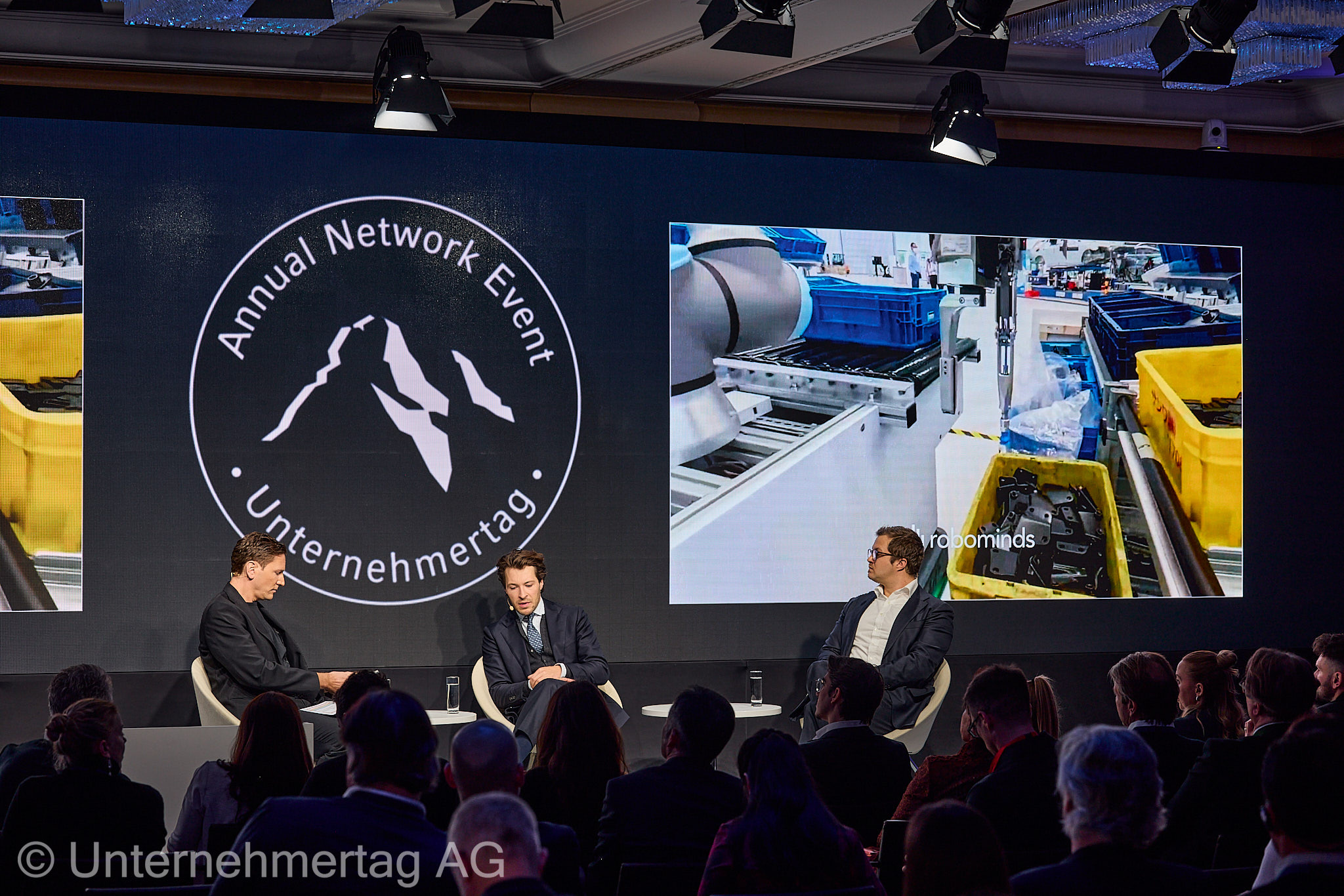
Robotics is advancing at remarkable speed, and Europe continues to play an important role in shaping its future. Moderated by Philipp Hartmann (General Partner at Mountain X), the discussion with Niko Bullwinkel (CEO of Circus Group) and Tobias Rietzler (CEO and founder of robominds) made clear that Germany and Europe still possess significant strengths in areas such as industrial automation, engineering and application excellence. At the same time, competition is increasingly shifting away from hardware and towards software and intelligent integration.
At the heart of the conversation was the question of how robotics and AI will transform everyday life, industrial processes and entire supply systems in the years ahead. While robots were once largely confined to traditional industries such as automotive and pharmaceuticals, falling hardware costs and rapid progress in AI are now opening up entirely new fields of application, ranging from logistics and healthcare to food processing and service industries.
One point became particularly clear: hardware alone is no longer the decisive factor. Robotics components are becoming cheaper and increasingly commoditised. The real competitive advantage today lies in intelligent software, specialised applications and the ability to integrate robotic systems effectively into existing infrastructures.
The concept of “physical AI” also played a central role throughout the discussion. Future robots are expected not merely to perform simple movements, but to understand and execute complex tasks autonomously. At the same time, the panel expressed scepticism towards the idea that humanoid robots will dominate the future. Rather than one universal machine capable of everything, the more likely scenario is the emergence of highly specialised autonomous systems designed to perform specific tasks far more efficiently than human-like robots.
Another key theme was the shortage of skilled labour. Robotics was not framed as a replacement for people, but as a way to relieve employees of repetitive tasks and allow them to focus on more valuable and demanding work, whether in healthcare, manufacturing or logistics.
Alongside the opportunities, several challenges were also highlighted. One of the main barriers to growth is no longer the hardware or even AI itself, but the complexity of integration into existing corporate systems and operational processes. Differing ERP, payment and inventory management systems often make large-scale deployment considerably more difficult.
Despite growing global competition, particularly from Asia, the overall tone of the discussion remained optimistic. Europe’s strength, it was argued, still lies in technical excellence, engineering expertise and the ability to develop high-quality applications. These are precisely the capabilities Europe should build upon more decisively in the future.
Key Takeaways
• The future of robotics will increasingly be driven by software, AI and intelligent integration rather than hardware alone.
• Falling costs for robotics components are opening up entirely new mass markets far beyond traditional industry.
• Highly specialised autonomous systems currently appear more realistic and efficient than universal humanoid robots.
• Robotics can help address labour shortages by relieving people of repetitive tasks.
• The greatest challenge often lies not in the technology itself, but in integrating it into existing systems and workflows.
• Germany and Europe continue to hold strong positions in engineering, industrial automation and application excellence.
• Europe must make more strategic use of its technological strengths in order to remain globally competitive.
Poto: Unternehmertag/Urs Golling
.svg)
.svg)
%201.svg)