.svg)
Key Takeaways of the discussion with Dr Michael Schöllhorn, CEO Airbus Defence & Space, moderated by Chris Lunday, POLITICO Europe
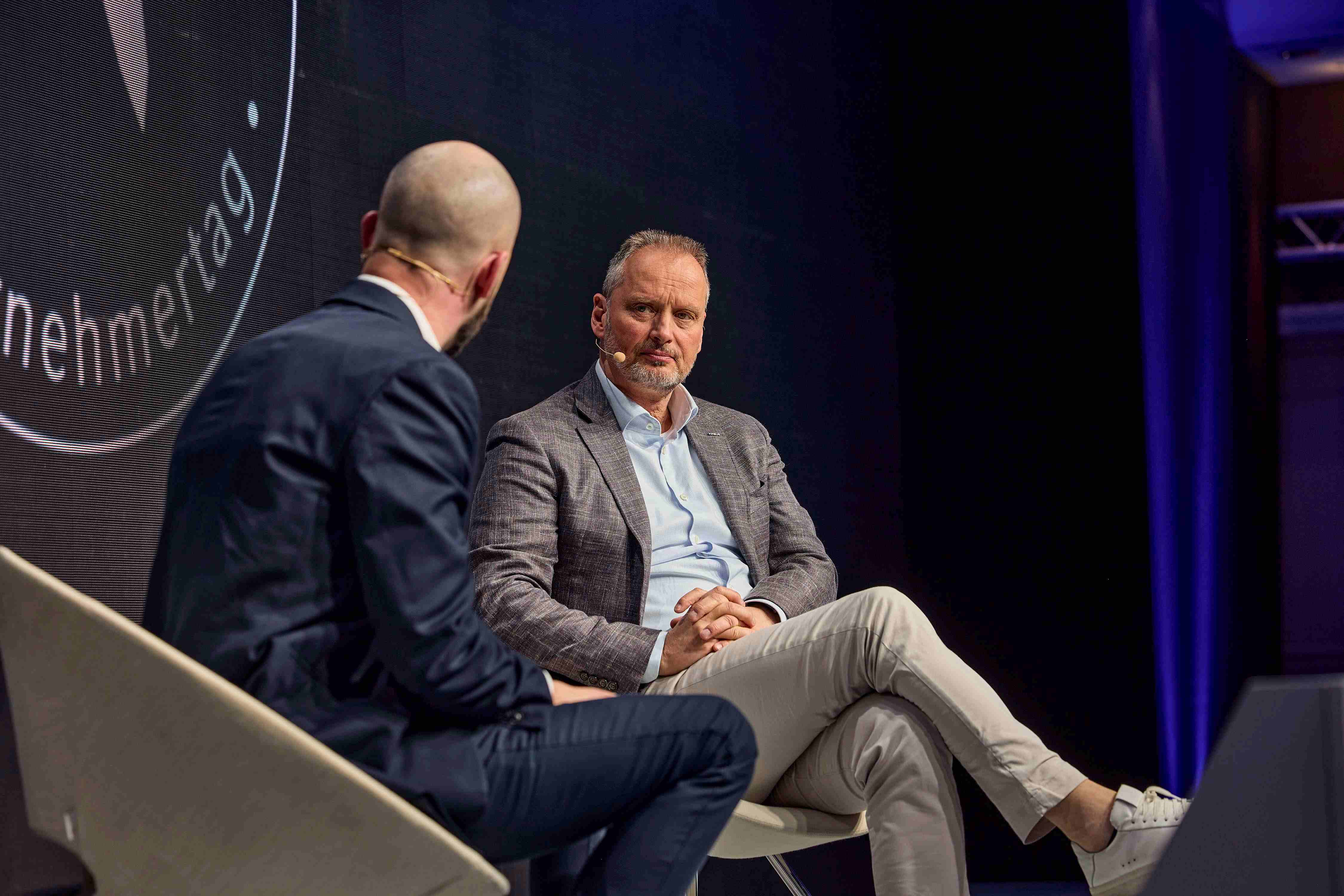
Europe finds itself at a decisive moment in security policy. The discussion with Dr Michael Schöllhorn, CEO of Airbus Defence & Space (conducted on 19 March 2026 by POLITICO reporter Chris Lunday at the Unternehmertag) made clear that while the scale of the threat is now widely recognised, significant gaps remain in terms of speed, execution and strategic coherence.
For decades, defence was politically and socially neglected. Only recent geopolitical developments, most notably the war in Ukraine, have triggered a fundamental shift in mindset. Today, the question is no longer whether Europe needs to act, but how quickly and decisively it can do so.
A central theme was the role of the United States. While transatlantic ties remain important, it has become increasingly evident that Europe can no longer rely on long-term American security guarantees alone. The strategic focus of the US is shifting towards the Indo-Pacific. As a result, Europe must take far greater responsibility for its own defence.
The issue of financing was addressed with equal candour. Increased defence spending is widely seen as unavoidable. What matters now is ensuring that these resources are deployed intelligently and effectively. In this context, the discussion highlighted Europe’s continued dependence on non-European suppliers. A stronger focus on domestic and European industry could not only enhance strategic autonomy but also drive innovation and economic value within Europe.
The Franco-German FCAS project served as a case in point for the structural challenges of European cooperation. Industrial rivalries and politically driven compromises continue to slow progress. At the same time, it was emphasised that the future of defence lies less in individual platforms and more in their integration – particularly through what is referred to as a “combat cloud”.
Another key area of growth and innovation is space. Satellite infrastructure and data connectivity are gaining strategic importance at pace, not least due to their critical role in the war in Ukraine.
Overall, the conversation underlined that Europe has the resources and capabilities required to ensure its own security. The decisive factor will be whether these can be aligned and deployed with clarity and determination.
Key Takeaways
● Europe has recognised the new security reality but continues to struggle with decisive implementation.
● The United States will play a reduced role in Europe’s security going forward; greater self-reliance is essential. Higher defence spending is unavoidable; the focus must now be on its effective and strategic allocation.
● Strategic dependencies, particularly on the US, remain a significant vulnerability.
● A strong European defence industry and a long-term industrial strategy are prerequisites for genuine sovereignty.
● European cooperation is often hindered by industrial rivalries, a lack of capability for cooperation and political compromise.
● The future of defence lies in connectivity, data and space infrastructure, not solely in traditional platforms and domains.
● Defence exports are increasingly – and finally also in Germany – seen as a strategic tool of foreign policy.
Photo: Unternehmertag/Urs Golling
.svg)
.svg)
%201.svg)