.svg)
A look back at the conversation with Graça Machel-Mandela, moderated by Conny Boersch
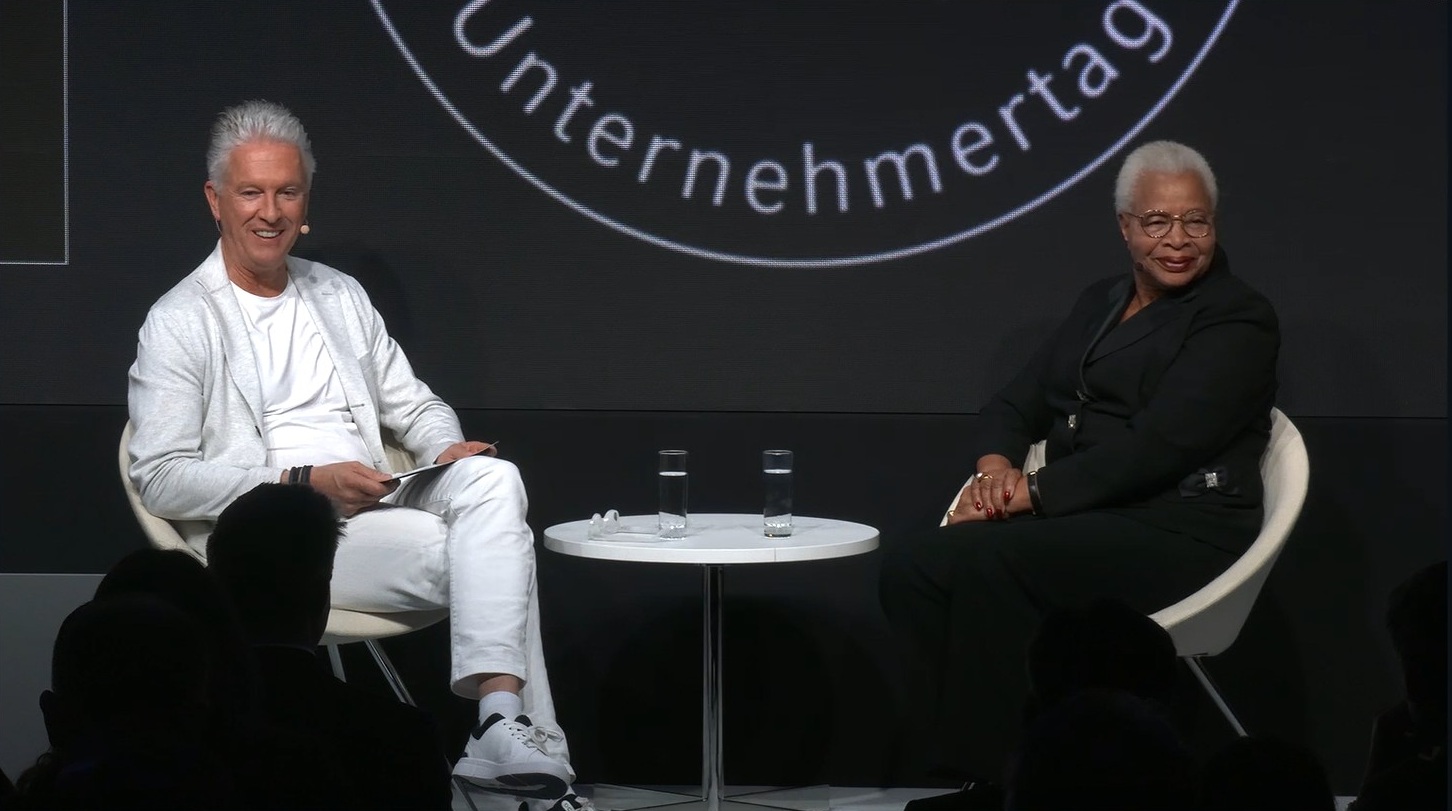
Graça Machel-Mandela is one of the most influential women on the African continent. Born in Mozambique in 1945, she became Minister of Education at the age of just 29 following independence, making her the first woman ever to serve in her country’s cabinet. She is a freedom fighter, a tireless advocate for the rights of women and children, and the only woman in the world to have been married to two presidents: Samora Machel and Nelson Mandela.
Yet she never stood in the shadow of these two great African leaders. Instead, she has always pursued her own distinct political path.
Machel describes her life as a series of opportunities—and the responsibility that comes with them. Growing up in modest circumstances, she became aware early on that education and opportunity are never to be taken for granted.
A defining moment in her youth was her experience of colonial inequality. Although she attended school in Mozambique, she was the only black child in a class of forty. It was then, she says, that her political awareness began to take shape.
This awareness evolved into a lifelong commitment to fighting inequality and advocating for the rights of women and children—paired with a willingness to place her own life in service of a greater cause.
What drives her is not personal ambition, but a deep sense of duty: to give back what she herself has received. This conviction is also shaped by her experiences in eight conflict regions, where she witnessed suffering, loss and human vulnerability at first hand. Her response is striking: transformation rather than bitterness. She speaks of turning the pain she has absorbed into joy, hope and energy for others.
In her conversation with Conny Boersch, it quickly becomes clear that this is not just a witness to history speaking, but a moral authority. And she has a message: Africa does not need charity. Africa needs partnerships on equal terms.
Looking out at the audience, Machel points out that Europe still does not fully have Africa on its radar—and is therefore missing out on enormous opportunities. Rich in natural resources, talent and potential, the continent is still too often overlooked or reduced to the role of an aid recipient. Yet the reality has long since changed: Africa is a key pillar of global value chains, particularly in future technologies.
A large share of the raw materials required for AI, the energy transition and digitalisation comes from Africa. At the same time, the world’s youngest population is growing there. For Machel-Mandela, the conclusion is clear: a successful future can only be built together.
A particular focus of her work is the role of women. Machel emphasises that investing in women is not only economically sound, but socially transformative. Women invest in their families and communities, creating sustainable structures. In many African countries, female entrepreneurship is already a key driver of growth. Or, in her words: when women are empowered, entire societies grow.
At the same time, she offers a broader reflection. In an era dominated by discussions around defence, AI and geopolitical power, the human being must not be forgotten—it must remain at the centre. Conflicts cannot be resolved through technological superiority alone. What is needed is empathy, dialogue and a willingness to find shared solutions.
Key Takeaways:
• Africa must become part of the global agenda
• A shift from development aid to partnership and interdependence
• Africa is central to resources, technology and demographic development
• Knowledge transfer and local value creation are essential
• Women are a key lever for sustainable growth
• Leadership means listening, deciding and taking responsibility
• Technology needs a human foundation
• Europe’s future is inseparably linked to Africa’s future
Conclusion:
Graça Machel-Mandela puts it succinctly: Africa is not a footnote in global development—it is one of its defining forces.
Anyone seeking to shape the future will not be able to do so without Africa.
And above all, not without the people who will build it.
.svg)
.svg)
%201.svg)