.svg)
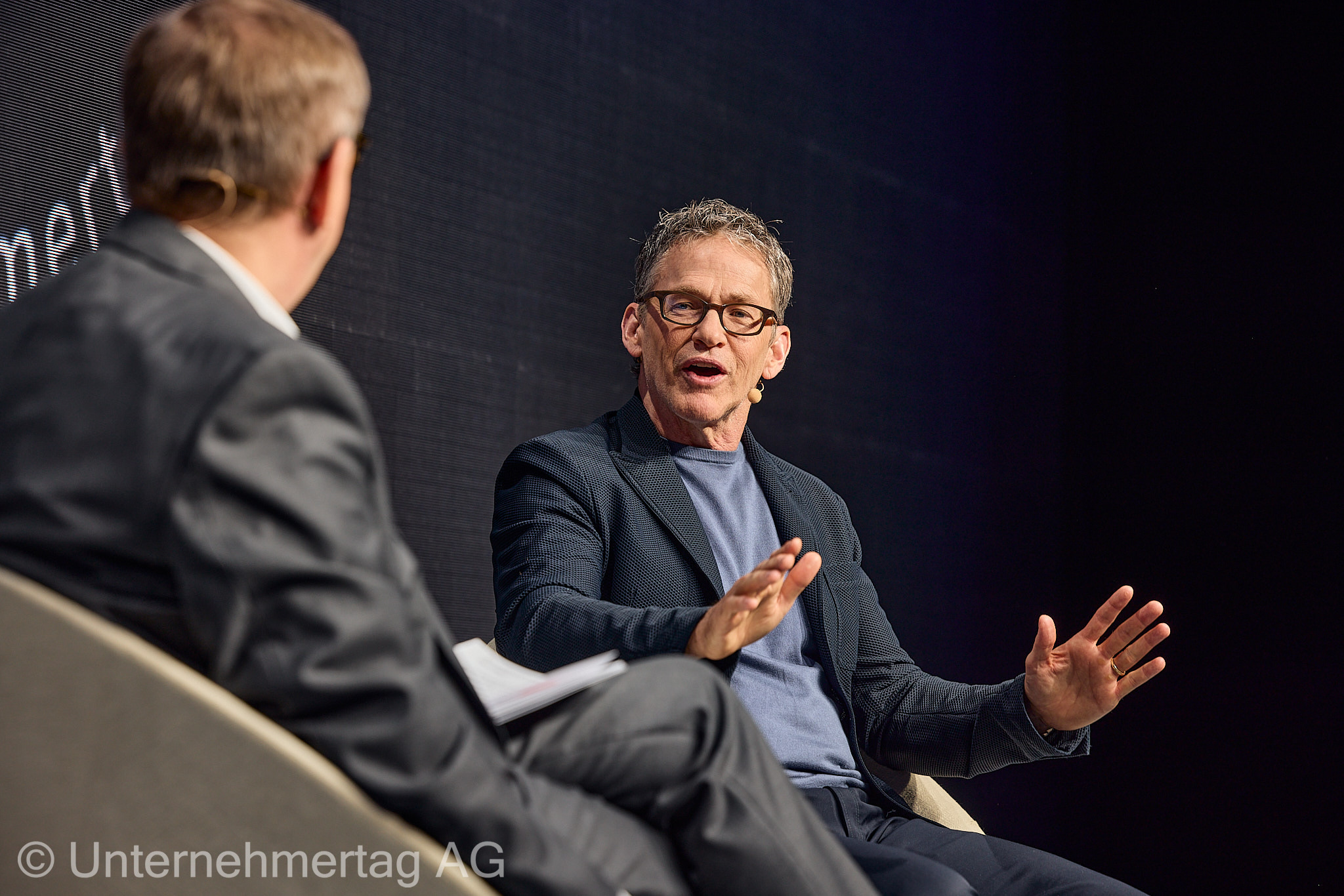
Excerpt from the FOCUS Money Talk with Bayer CEO Bill Anderson at the Unternehmertag
FOCUS Money: Geopolitical tensions have reached a new peak. How is Bayer dealing with the Iran conflict and its consequences?
Bill Anderson: Our first priority is the safety of our employees in the Near and Middle East. We have around 500 staff in the region and remain in close contact with them. Everyone is currently safe and well.
FOCUS Money: And your second priority?
Anderson: We hope and pray for a swift resolution to the conflict, so that people in the region can look ahead again. We are making an important contribution by providing essential medicines as well as health and agricultural products to people on the ground.
FOCUS Money: The Strait of Hormuz is effectively blocked by Iran. There is no shipment of oil, gas or phosphate. How much is Bayer affected by this supply bottleneck?
Anderson: The disruption of this trade route in the Gulf region currently poses a relatively minor challenge for our business, as we are less directly dependent on these raw materials and operate a globally diversified production and distribution network. However, we are monitoring the situation closely, as it could naturally also affect our customers worldwide.
FOCUS Money: You have recently spent considerable time in India and China. What can we learn from the two largest countries in the world?
Anderson: Over the past months, I have spent around a third of my time in Germany, as well as a significant amount of time in the United States, and most recently in India, China and Brazil. What strikes me is that in Europe we still talk too much about regulation and safeguarding prosperity. Elsewhere, different issues are at the forefront – particularly global leadership, economic dynamism and growing prosperity. Europe needs to reposition itself in this multipolar world and take action – and do so quickly. That requires clarity and a genuine willingness to drive change.
FOCUS Money: You mention overregulation in Europe. What needs to happen for us to become more competitive globally again?
Anderson: The idea of cutting bureaucracy, as it is currently being discussed, will simply not work. Let me give you an example: as a company, we must comply with laws, guidelines and regulations that amount to around 40,000 pages in total. How quickly is deregulation supposed to happen under those conditions?
FOCUS Money: You tell me…
Anderson: …five or ten regulations a day? Would the problem be solved with 38,000 pages of rules remaining? I rather fear that new bureaucratic regulations will be created faster than existing ones are removed. That is not how you win the battle against bureaucracy.
FOCUS Money: What is the alternative?
Anderson: If Europe wants to catch up technologically and compete on equal footing, we should not simply abolish only absolutely essential laws. Being a global leader in regulation does not create value or prosperity. I am therefore concerned that, when it comes to artificial intelligence, the instinct once again is to regulate every conceivable scenario immediately. The fact that theft and fraud are illegal is already sufficiently covered by existing laws.
FOCUS Money: How are you addressing internal bureaucracy within a DAX-listed group like Bayer?
Anderson: When I joined Bayer in spring 2023, there was an internal rulebook of 1,362 pages. It was expected that our 100,000 employees would follow all the rules, guidelines and processes contained within it.
FOCUS Money: What did you do with that handbook?
Anderson: We threw it in the bin and instead defined a small number of core principles. Of course, as a company we are obliged to comply with all legal and local requirements. But you do not combat bureaucracy by reducing a 1,362-page rulebook to 1,000 pages.
FOCUS Money: Over the past three years, you have radically restructured Bayer, cutting two-thirds of management roles and reducing the workforce by 12,000. Is this a model for the European Commission?
Anderson: I can only speak for Bayer. When I arrived, we had 15,000 managers for 100,000 employees. Our goal is for 95 per cent of decisions to be made by those who actually do the work. That is why we eliminated around two-thirds of management positions – which does not mean we no longer need the expertise of those colleagues.
FOCUS Money: What does that mean in practice?
Anderson: Many former managers now focus entirely on developing better products and solutions for our customers, rather than approving travel expenses or overseeing their teams. A marketing manager previously led four or five people, even though they might have been the most creative person in the team. I told them: we need your creative talent in marketing, not in managing colleagues.
FOCUS Money: How did employees react? With shock?
Anderson: Many were initially shocked. But over time, colleagues have experienced that things move much faster and more effectively without rigid hierarchies. People join Bayer because they want to contribute to health and nutrition. Under rigid structures, they could achieve very little. That has changed. Today, we have empowered teams that decide what resources they truly need. There is no longer an annual budget. Instead, we work in 90-day cycles and adjust priorities and resources dynamically. This also applies to the Board. In this way, we combine the speed of a start-up with the capabilities of a global player.
FOCUS Money: Is Bayer’s transformation now complete?
Anderson: The major organisational changes are largely complete. However, continuous improvement within the new system is ongoing. We are seeing many positive results, which encourages us to keep pushing forward.
FOCUS Money: When presenting your annual results, you said 2026 would be a solid year. Will the golden years return in 2027?
Anderson: When I joined Bayer, we were facing major challenges: patent expiries in key pharmaceutical products, strong competition from Asia in crop protection, the bureaucracy of a company over 160 years old, high levels of debt and the glyphosate litigation in the United States. For each of these five core challenges, we have developed robust plans, which we are consistently implementing this year. As a result, we expect to return to mid-single-digit revenue growth in pharmaceuticals by 2027 and to launch several important products in our agricultural business.
FOCUS Money: You joined Bayer in 2023 to tackle the glyphosate litigation in the US. Will there be a breakthrough this year?
Anderson: We are making good progress. We have announced a comprehensive settlement in the US litigation, which still requires final court approval. Most recently, we increased our provisions to nearly €12 billion to resolve current and future claims. The US Supreme Court will also review our case in the coming months. So we are moving forward.
FOCUS Money: Bayer plays a key role in the United States, as you are the only manufacturer of glyphosate there. Farmers depend on your products. Is the Trump administration helpful or harmful for Bayer?
Anderson: We work with the governments of all countries in which we operate and generally maintain good relationships with policymakers. The Trump administration places strong emphasis on farmers and their needs, which is certainly the right approach. Contrary to popular belief, food does not simply come from supermarkets – it must be grown. And that requires the right framework conditions. In the EU, dependence on food imports is actually increasing. Feed for cattle, poultry and pigs increasingly comes from Latin America. One reason for this is Europe’s long-standing reluctance to accept genetically modified seeds – a technology that has been proven safe over decades of use.
FOCUS Money: You have extended your contract as CEO until March 2029. Where will Bayer be in three years’ time?
Anderson: My goal is to make Bayer the leanest, fastest and most innovative life sciences company in the world. We are evolving into an organisation with thousands of fast-moving teams around the globe, all benefiting from the strengths of a large company. For example, it would take decades for anyone to build the infrastructure required to produce seeds in 80 countries.
Photo: Urs Golling/Unternehmertag
.svg)
.svg)
%201.svg)