.svg)
A Lookback at the Panel Discussion with Dr Claudia Major and Prof Dr Sönke Neitzel
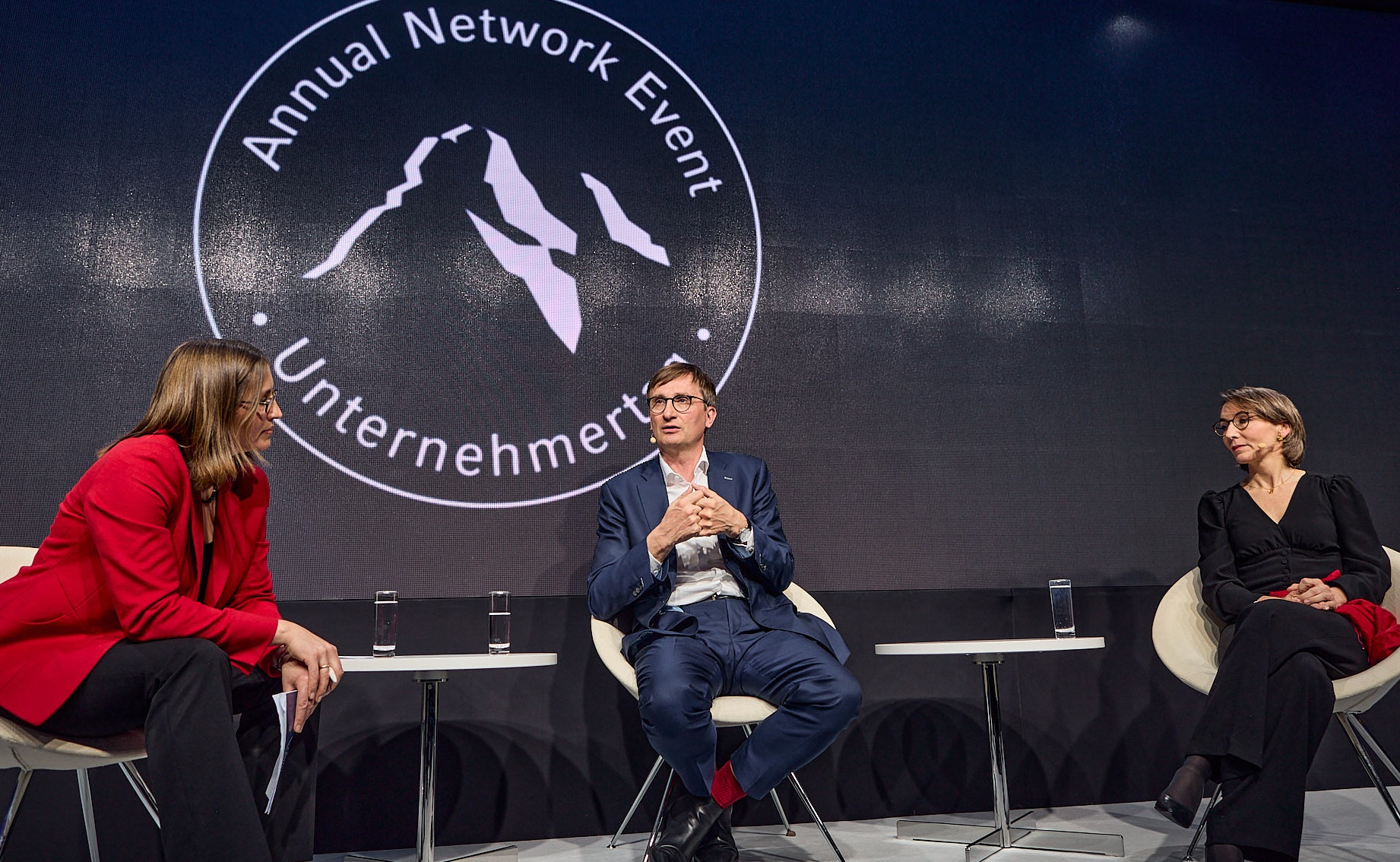
Die Diskussion zwischen der renommierten Sicherheitsexpertin Dr. Claudia Major (Senior Vice President Transatlantic Security, German Marshall Fund) und dem Historiker Prof. Dr. Sönke Neitzel (Professor of War Studies, University of Potsdam) centred on Europe’s defence dilemma, which, in the face of shifting geopolitical power dynamics, oscillates between ambition and reality (host: Anja Wehler-Schöck, Member of the Editorial Board, Der Tagesspiegel).
Because for decades, Europe’s strength has been rooted in diplomacy, cooperation and economic power. As the global landscape has evolved, military force has once again become a defining instrument of power. Yet Europe is not fully prepared for this reality.
The discussion made clear that Europe’s perceived weakness in defense is not at odds with its strong system of values. On the contrary, credible defense depends on a shared understanding of what needs to be protected. Values and security are closely intertwined.
While awareness of the challenges is high, implementation remains limited. Many of the necessary steps – from increasing defense spending to strengthening capabilities – are well understood. However, political fragmentation, national interests and a lack of clear leadership continue to slow progress.
A central issue is Europe’s long-standing reliance on the United States. As this support becomes less predictable, Europe faces the urgent task of redefining its own security architecture. This requires not only investment, but also a fundamental shift in mindset: from dependence to responsibility.
At the same time, expectations towards Germany are rising. Economically and politically, Germany is increasingly seen as a potential leader in European defense. This represents both an opportunity and a challenge, given historical sensitivities and differing perspectives among European partners.
Despite notable progress in recent years – often triggered by external shocks – significant gaps remain. Europe still lacks critical capabilities in areas such as air and missile defense, reconnaissance, cyber security, logistics and troop strength. The key challenge is not only to improve, but to reach a level that is sufficient in the current geopolitical context.
Proposals such as a European army were met with scepticism. Rather than creating new structures, the focus should be on clearly defining the problems to be solved and strengthening existing frameworks.
Ultimately, the future of European security will depend less on institutional design and more on political will. The discussion highlighted the need for a profound mental shift: Europe must take ownership of its own defense, regardless of external support.
The underlying question remains: what role does Europe want to play in a changing world – and is it prepared to defend it? Who do wen want to be as 450 million Europeans?
Photo: Anja Wehler-Schöck, Sönke Neitzel, Claudia Major (from left to right), ©Unternehmertag/Urs Golling
.svg)
.svg)
%201.svg)