.svg)
Summary of the Panel "Europe Unplugged. Digital Sovereignty – Now Or Never
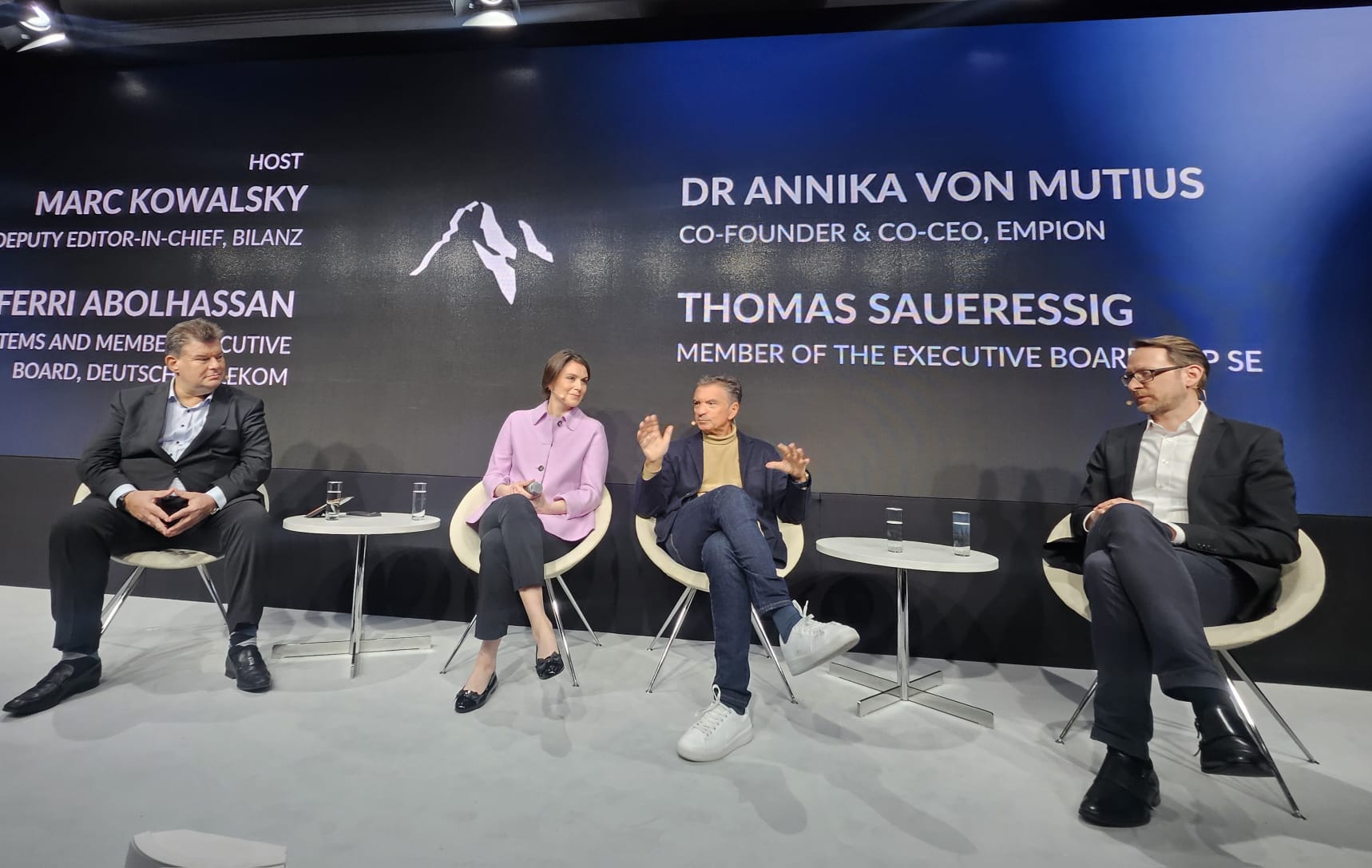
With Dr Ferri Abolhassan (CEO T-Systems, Member of the Executive Board, Deutsche Telekom), Dr Annika von Mutius (Co-Founder & Co-CEO, Empion, Board Member of the German AI Association), Thomas Saueressig (Member of the Executive Board, SAP SE), Host: Marc Kowalsky (Deputy Editor-in-Chief, BILANZ)
The discussion centred on the question of how Europe can regain digital sovereignty without retreating into technological isolation. The starting point was Europe’s significant dependence on American technologies: more than 80 per cent of critical digital infrastructure and software solutions originate outside Europe, particularly in the United States. The panellists described this dependence not only as an economic issue, but increasingly as a geopolitical risk.
At the same time, the overall tone of the panel was strikingly optimistic. Europe, the speakers argued, should not attempt to imitate either the US or China, but instead focus decisively on its own strengths. Particular emphasis was placed on Europe’s industrial expertise, the quality of its research and education, and the vast amount of specialised industrial data held by European companies. These assets, the panel suggested, could become the foundation for Europe’s own AI and technology solutions.
A central theme was that Europe’s greatest opportunity lies not in competing on generic large language models, but in developing specialised AI systems for industry, manufacturing, engineering, chemicals and logistics. In these sectors, Europe possesses decades of accumulated expertise and proprietary industrial data that would be extremely difficult to replicate elsewhere. AI, it was argued, should primarily be applied where it creates tangible industrial value rather than merely powering consumer-facing applications or chatbots.
Several speakers stressed that Europe already has world-class companies, talent and research institutions, but too often fails to connect these strengths effectively. Europe’s fragmentation was repeatedly identified as one of its greatest structural challenges: differing national regulations, limited scalability and a fragmented internal market continue to slow innovation and prevent the emergence of true European champions. At the same time, Airbus was cited as proof that successful European cooperation is possible.
The pace of innovation also featured prominently throughout the discussion. Compared with the US, China and even Ukraine, Europe was described as too slow, overly regulated and excessively cautious. While innovation cycles elsewhere are accelerating dramatically, Europe often loses momentum through bureaucracy, regulatory complexity and overlapping responsibilities. The panel repeatedly called for a faster transition from strategy to implementation.
On the subject of AI, there was broad agreement that the technology is no longer a future trend, but already a decisive factor for productivity and competitiveness today. At the same time, the speakers pointed out that too few companies are currently using AI productively at scale. The conversation therefore also focused on trust, governance and adoption. Europe, the panel argued, has the opportunity to set global standards in areas such as data protection, security and responsible AI use, turning these values into a competitive advantage.
The panel also explored how Europe should position itself in relation to global technology giants. The speakers did not advocate isolationism, but rather the sovereign use of international technologies. The crucial issue, they argued, is retaining control over critical data, infrastructure and key technologies. Digital sovereignty should not be seen as the opposite of innovation, but as one of its essential foundations.
China also featured prominently in the discussion. While the panellists clearly rejected the Chinese political model, they acknowledged the extraordinary speed and determination with which China is advancing technological innovation. Particular attention was drawn to the scale of investment in AI, robotics, quantum computing and fusion energy. Europe, they argued, must learn to think more long-term and invest more boldly in future technologies.
Despite all the challenges discussed, the panel concluded on a distinctly positive note: Europe already possesses the talent, companies, data and technologies it needs. The decisive question now is whether Europe can act faster, cooperate more effectively and develop the confidence to pursue its own technological path with greater determination.
.svg)
.svg)
%201.svg)